Pictures Books About Moving


Pardon my absence; I've been trying to organize my thoughts before I pack up for a move.

We've lived in this apartment for three years. We brought our baby home here. We watched her grow curious and talkative in this living room. She cut teeth in that bedroom. She sits back with a book in that nook. We greet the ducks in the pond in the spring, and worry about the fish in the pond all winter. 

I have been thinking of ways to ease the transition away from this living room and this bedroom and this pond to the three new homes we'll make in the coming year. I suspect the transition(s) will be much more difficult for me than for almost-two-year-old Baby A. 

Of course, there are books for that. I've been trying to keep Tsh Oxenreider's advice in Organized Simplicity in mind as I decide what I want waiting for me in storage during the upcoming summer sub-lease and fall internship. Picture books can guide me to comforting pictures and words to give Baby A and myself, and maybe my husband, too. 

Are you planning a move?
A New York Times article suggests two recently published picture books about reluctant movers.
And this squidoo article lists ten picture books about moving (giving a review of eight), so the angle you and I may be looking to take is sure to be illustrated in one of them.

It seems most picture books about moving are directed at bike-riding, best-friend-making six-to-nine-year-old children. Do you think that's the toughest age for moving, or just the easiest age period for which to articulate a picture book? 

I would guess teenagers would have the toughest time--do you think a teenager would secretly appreciate a picture book about moving (particularly one not featuring a little kid)?

image: cover of Half A World Away by Libby Gleeson, illustrated by Freya Blackwood


P.S. I'll be back in the swing of things here next week. Happy reading until then! Err...and after then, too. 

Springtime Traditions

Happy Spring! I thought it was fitting to kick off the official start of spring by hanging out some hope in the magic of nature--I made my second annual tree wish. I use only ribbons and things around my house, and write my wish on a scrap of paper. I try to make it appealing to birds, in the hopes that they'll steal the ribbon for their nests, which I'm sure would be extra good luck. This year, I hung it two-and-a-half-stories high in the tree by leaning over my stair well.
(Can you spot my escaped, barefoot toddler?)


My mom reminded me that this year is the centennial celebration of Washington D.C.'s cherry blossoms. I grew up near D.C., and both the cherry blossoms and dogwood blossoms bloomed divinely for weeks.
I'd love to add these books to my collection as a reminder of my fourteen years in Virginia.
Remarkable Trees of Virginia illustrated by Robert Llewellyn and written by Nancy R. Hugo
Eliza's Cherry Trees: Japan's Gift to America written by Andrea Zimmerman, illustrated by Ju Hong Chin

Don't you think a book collection can tell a version of a person's life? And isn't springtime a perfect time to both reminisce and look forward with hope?
 

P.S. Tell me if you make your own tree wish--I'd love to see!
P.P.S. my springtime book picks

Pre-Literacy: Phonological Awareness

 
Phonological Awareness--meaning, an understanding of how sounds are organized and used in language--is fostered both overtly and subtly in education.

Overtly, speech pathologists (and other educators) use speech cues to help students recognize sound/speech patterns. I am fascinated by the patterns, and if you are, too, you can study these speech cue cards

Subtly, there are a world of silly songs and poems and stories that foster phonological awareness. Do you remember singing, "I like to ate, ate, ate, aples and baynaynays [...] eat, eat, eat, eeples and beneenees..." ("Silly Song" by Raffi)? It turns out that silliness had a secret mission.

What books help teach phonological awareness?

There are so many fantastic rhyming books! Baby A is far from making rhymes or recognizing sound cluster patterns, but she currently has an obsession with "Pop a Pop", otherwise known as Hop on Pop by Dr. Seuss.

My sister is an avid reader and all-around intelligent person, so I trust her (and millions of others') childhood favorite wordsmith Shel Silverstein. And it's no secret I'm a huge Sandra Boynton fan.

But not all of Silverstein's or Boynton's or other excellent author's books rhyme, and many good books that don't rhyme are great for practicing phonological awareness. Read books that are charming, and curiosity will lead to learning.

Once a child knows how to read, it is still useful and fun to practice phonological awareness, and its cousin, spelling. I like the letter rocks pictured up top, and I've seen some with clusters like "ing".

Here's the rest of the Pre-Literacy series:
Narrative Skills

(To clarify, pre-literacy skills develop at different paces, and not necessarily in a particular sequence, for each person.)


P.S. letter rock games
P.P.S. St. Patrick's Day book + party ideas

Have a lucky weekend!


St. Patrick's Day Party: Atypical Books and Activities

My friends and I are planning a St. Patrick's Day party for our 1-2-year-olds this weekend. My elementary school self loved doing the leprechaun treasure hunts leading to a pot of gold coin chocolates every year, and I was sure that one day I would find the end of a rainbow. I haven't yet. But for the next generation's younger crowd, I'm thinking balloons in rainbow colors and Baby A's favorite treasure: fruit snacks.


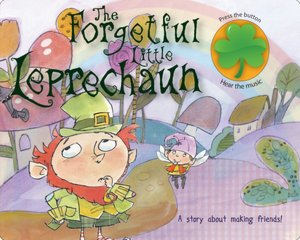
This musical board book would be a fun way to kick off a rainbow-treasure-friendship party. The Forgetful Little Leprechaun gets help from friends to find his pot of gold, which (spoiler alert!) he left at the end of the rainbow, of course. His friendships are his true treasure in the end. (I am geeking myself out.) The text is fun and the music is actually nice; it plays the tune "Irish Eyes Are Smiling".

Or, if you want something outside of the pot-of-gold, play up the (probably untrue) but fun legend of St. Patrick banishing snakes from Ireland.


I haven't read The Last Snake In Ireland, but it looks intriguing. For a party theme, you could hide a tiny rubber snake in one of many cupcakes decorated green like the hills of Ireland, and whoever gets it is "it" in a game of Sardines, or first up in an obstacle course. Goodie bags or treats could include sour gummy worms masquerading as snakes, homemade bread sticks shaped like snakes, or celery cut and shaped to look like a squiggling snake.


For a fun and easy game in the traditional rainbow route: Crafting Chicks Find the Colors of the Rainbow Treasure Hunt {free printables}

Got any Irish-luck plans up your sleeves? Do you know of any fun books about Ireland or St. Patty? Or snakes?

Pre-Literacy: Narrative Skills


Okay, that video has been around for years. But I don't think there is a more adorable and appropriate way to introduce the pre-literacy skill of narration. When a child understands that stories have structure (usually: beginning, conflict, end), and has the short-term memory to explain elements of a story (characters, setting) or to retell a story they've heard or experienced, they have narrative skills. Speech-Language Pathologist Rachel Betzen explained kindergarten-readiness/pre-literacy skills at preliteracy.com, and I stole these narrative-related skills from her checklist:
  •  be able to talk about about his or her everyday experiences
  •   understand two-step verbal directions
  •   understand and remember simple stories
  •   understand 2-3 steps involved in sequences of events or stories
  •   be able to answer simple questions about stories and routine experiences
(end quote) 
Encourage narrative skills by:
  • ask about her or his everyday experiences
  • give two-step verbal directions, and help her or him follow through (ex: Choose a book and bring it to me; Pick up your fork and put it on the table)
  •  ask for help telling a story she or he is familiar with; ask her or him to "read" a favorite picture book to you; perform fingerplays that tell a story, (such as "Itsy Bitsy Spider"); invite her or him to retell a story (ex: tell Grandma about when you saw the dolphins)
  • ask questions about a story: What happened at the beginning of the story?; And then what happened?; Why did he feel sad/frustrated/excited?; Did that [solve the problem]?; What happened at the end?
  • ask simple questions about stories and routine experiences: Where does [the main character] of this book live?; What do you do first every day when you wake up? 

Do you already read, talk, and play like this? What books do your pre-literate tots "read" to you? 

Baby A is currently all about the "Oops!" Hassu kalkkuna! [Silly turkey!] in Boynton's Blue Hat, Green Hat. And look, there's an app for it.


Three Picture Books to Welcome Spring

Spring is only two weeks away! I feel refreshed just perusing the soft, but bursting images of picture books about springtime, especially when they are crafted with the grace of a cherry blossom, like these:

Snow Rabbit, Spring Rabbit: A Book of Changing Seasons (in the UK as Brrrr: A Book of Winter) by Il Sung Na. A whimsy-laced but careful intention floods all of Na's art. I love The Thingamabob, but it's almost as if Na's signature speckle and swirl watercolor details were destined for the nature elements explored in this book.


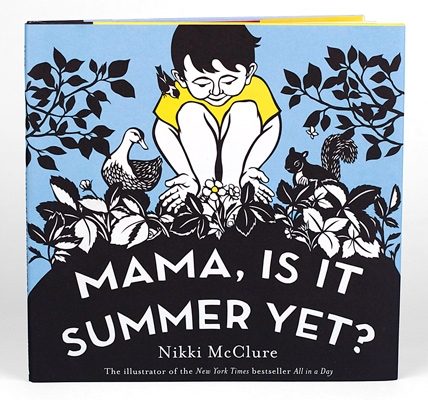
Mama, Is It Summer Yet? by Nicole McClure. This book stretches through the changes and wonder of spring into summer. See more and learn more here, and read an interview that coincidentally lit up my Google Reader today.
I feel personally drawn to this book because Baby A has been asking to go swimming for weeks (she's a summer girl like me!) but I keep having to remind her that it is still winter. Now I can use this gorgeous book to find the images and words I'm searching for to explain the cues in nature for the coming of spring, and then summer on its heels.


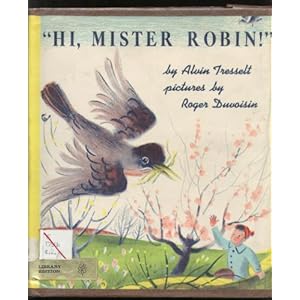
Hi, Mr. Robin! by Alvin Tresselt, pictures by Roger Duvoisin. A beaut' first published in 1950, this stole my heart with its sweet text encapsulating a child's budding patience and eagerness for spring, and its classic, lively illustrations. It would be lovely to hear it read aloud by a Level 1-2 reader (in the most common edition it's 28 pages, with about half of those pages filled with medium-sized text).


I hope you'll soon be reading one of these with a child or with your inner child. 

P.S. Remember how blessed you are to be empowered by literacy on World Read Aloud Day, (tomorrow) March 7th!


Pre-Literacy: Letter Recognition

Letter Recognition: Recognizing the Letters of the Alphabet. You probably put that together on your own. Once you're in the thick of practicing letter recognition, you'll correlate objects and letters and say stuff like, "A is for apple. And Anna. And Alexandra." Just me?

A kindergarten teacher recently told me that almost all of her students wrote their names at the beginning of the school year--in CAPS only. She guessed it was because their parents taught them the capital letters, and then taught them to write their name with those letters. 52 symbols is a lot for a four-year-old to master, and no parent wants their child to be the only one not writing, do they? The pressure to write and read at earlier and earlier ages is intensifying, which I fear is imposing pressure on toddlers rather than facilitating growth in their natural desire to learn. 

Teach and practice letters as early and as often as you and your tot like, but make sure it's for fun! I looked no further than Pinterest to find my favorite letter-practicing ideas (but I'm linking to original sources):


"Fishing for Knowledge" (letters written on juice lids fishing game instructions)

magnet letter matching tutorial


Tag Toys motor letters
These are gorgeous but too pricey for me--any DIY ideas? (I am imagining a small peg with buttons attached to each end through chipboard carved with an Exacto knife...)


P.S. ABC books and other alphabet gift ideas
Easy DIY dry-erase magnet board (cookie sheet)
Related Posts Plugin for WordPress, Blogger...